Friday, November 14, 2008

All Souls Day


If the Halloween celebration was pure-tourist, the next day I got to witness a holiday that was pure Chapín—All Souls Day. In Guatemala, the tradition is to fly kites as a way to connect the living on earth to the souls of the departed in Heaven. It’s also traditional to visit the cemeteries. The biggest and most famous celebration of the holiday in Guatemala just happened to be in Sacatepéquez, the department where we lived in during training (and where Antigua is). There are 3 towns that have the most famous celebrations and draw the big crowds, but my small training town also had a big celebration and I had promised my host family almost in the first week of training that I would go there to celebrate it with them.
In these towns, the people take the tradition of kite-flying to another level. Secret committees of young men in the town form to create paper maché kites as tall, or taller, than the houses. These enormous kites, supported by bamboo posts, can’t actually fly. The climax is when they are lifted into standing position off the ground, a process that involves a lot of ropes, poles and coordination… and many of the biggest ones crack as soon as they’re lifted, and supposedly sometimes they fall onto the crowd. This is a shame because the secret committees spend around 8 months making the most elaborate ones. The designs are incredibly intricate and beautiful and often depict a scene related to religion or traditional Mayan life.

Almost half of our training group ended up going to my small training town rather than the larger and more famous towns for the celebration which was a nice surprise (I was expecting at most only the 3 others girls that lived there during training). And it was really good to spend some time with my first host family. They surprised me with a birthday present of blue jeans that fit me perfectly (last thing I expected from a family of mostly women who wear traditional traje). I still have no idea how they managed to pick out my size, and they were very pleased to see me wear them. I also got to meet the volunteer that came after me and who had just graduated from training (so strange to not be the new kids on the block any more). We spent the morning watching the kites being raised and the smaller ones flying. Then I had lunch with my host family and visited the cemetery with them. They prayed at the grave of the son who was killed by gang members some years past (the gang mistook him for a member of a rival gang that they were hunting). Then they sat amongst the graves and ate corn on the cob and sweet potatoes. The cemetery was full of Guatemalan families doing the same thing, only some were eating pumpkin and other things. I was the only non-Guatemalan there, and I felt privileged to have a more complete experience of the holiday than the tourists who would only see the kites.

And it was interesting to see the calm even celebratory attitude of the Guatemalans as they visited their departed loved ones. I know my host family was sad in thinking about the loss of their family member—who had died so unjustly and at such a young age—but there were many smiles and jokes as well. The point seemed to be remembrance in peace, rather than remembrance in sorrow, and a true acceptance of their death. Such attitudes are not easy for anyone, but I felt like I saw more calmness and peace than I ever have in cemetery visits in the US.

All Hallows Eve


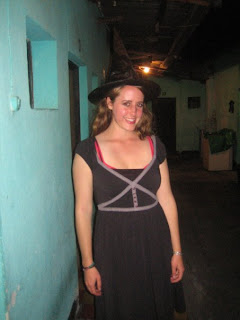
Conveniently, our 3 month in service conference Reconnect was scheduled for the week following Halloween weekend. So of course almost all the volunteers from our training group arrived on Friday to celebrate Halloween in Antigua. I had grand plans to be Dorothy from Wizard of Oz, playing up the fact that I live in the department of TOTOnicapan, and we’re certainly not in Kansas anymore. BUT, due to lack of funds/time and the scarcity of blue gingham dresses in Guatemala, it just didn’t come to together. So I had probably the most boring and obvious costume of my life—a witch (especially because I am a person who prides herself on the resourcefulness and creativity of her Halloween costumes). My parents had mailed me a simple, renaissance-style black dress that I had bought in Boston and I had just bought rather unattractive and orthopedic-like black shoes to wear to my students’ graduation that could be sort of witchy-ish. And because the city of Antigua is centered on the needs and desires of travelers (NOT Guatemalans, who generally don’t celebrate Halloween, as the general belief is that its devil-worship) I was able to find a witch’s hat… and fishnet stockings, just to make it slightly less boring.

But I guess if you’re ever going to go classic Halloween, it should be in Guatemala, where the very act of celebrating Halloween is rebellious and unorthodox. In the afternoon in one of the camionetas I saw a flier that had a picture of a witch flying on a broomstick with a circle and cross through it (like the non-smoking pictures), beside a picture of saintly Jesus. The print said, “Say yes to Dios, Say NO to Halloween.” I would have liked to keep it as a souvenir but I don’t think the driver would have appreciated that.

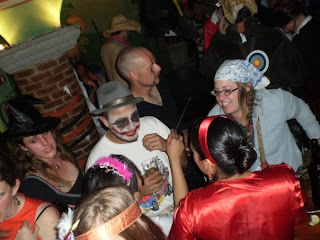
It was a fun night. Some of the costumes were much more impressive than mine, such as my friend Aliyya who wore nothing more than a costal (a plastic woven shopping bag) and my friend Amanda who was a very charming flapper girl. The biggest hit was probably Kelsey, who went as an “ayudante”, the men who collect the fares on the buses. She did an impressive impersonation of the ayudantes who frequently lift their shirts to rub their bellies and obnoxiously shout out the names of the buses destinations (“Chimal!Chimal!”) while rapidly waving their hand. Mostly it was good to “reconnect” with all the people from my training group, many of whom I hadn’t seen in 2 months. And obvious though my costume was, there was scarcely another witch in sight and I did get several compliments (even, “the cutest witch I’ve ever seen”).

Feliz cumpleanos to me

So this birthday was a memorable one, that's for sure, if only for how uneventful and, I'll admit it, downright depressing it was.

I had been bothered for a few days by a cough and head and body aches, but I woke up on Saturday, my birthday, feeling worse than ever. It was a gray day and already drizzling outside, which is a bad sign. Rain in the afternoon in Guatemala during the rainy season is an almost certainty, so when it rains in the morning, it means you're in for a full day of rain.

In an attempt to celebrate, I fixed myself some yummy French toast. Then I was determined to do laundry, despite the rain, and after breakfast, got started scrubbing in the outdoor (but thankfully covered) pila. None of the family members I saw wished me a happy birthday, but I wasn't too concerned. I figured we might have a little celebration at dinner, and perhaps it isn't the tradition here to wish a person a happy birthday various times throughout the day as it is in the States. I felt confident that they knew it was my birthday because I had mentioned it a couple of times to the sister as we did the dishes earlier in the week, and I had seen her tell the older mother. The sister had even told me, “We'll get you your birthday cake to celebrate.”

After a while of washing, I was feeling quite crummy and exhausted and dispirited by the rain, so I contented myself with washing only undergarments and socks and left the rest for another (perhaps sunnier) day. I passed the afternoon coughing in bed, sleeping and reading, and the rain continued. As the day wore on, I became less confident that the family was aware it was my birthday, as no one said anything.

My fears were confirmed when I was called down to dinner and there was no cake in sight. To make matters worse, for dinner I was served my absolute least favorite dish, in fact the only thing they make that I truly dislike. I don't know what the Spanish/K'iche' name is, but privately I call it “Pig Skin and Fat Chunk Soup”, which is basically what it is. A thick, greasy tomato-based soup filled with bits of tough, chewy pig skin and chunks of fat or tendons. Everyone else seems to really enjoy it, but it's a hard one for me (especially considering I've been mostly vegetarian for the past couple of years). The one perk was I also got a baked sweet potato. After finally getting down the soup, I relished the sweet potato and pretended it was my birthday cake. I also didn't have to wash the dishes, but I think this was due to the fact that they could tell I was sick and I finished eating later than the others.

I really can't feel too sorry for myself because, considering the number of mis-communications I've dealt with here in Guatemala, I shouldn't have trusted that mentioning it once to someone several days beforehand was good enough. It's also possible that this family doesn't celebrate adult birthdays because of their religion (I've heard some Evangelicals don't). And although I saw them celebrate the small girl's birthday, I haven't seen an adult birthday celebration in the family yet. Still, I find it odd that no one said anything. I don't think a friendly “Happy birthday!” would have really done too much religious damage.

I did get some wonderful phone calls throughout the day, including one from my first host family that almost made up for everything. They passed around the phone so every person could enthusiastically exclaim, “¡Feliz cumpleaños Yessica!” And of course my family back home called and were wonderful and sympathetic and serenaded me over the phone with “Happy birthday to you...”. And technically, I had already celebrated my birthday a week before, out dancing and drinking with my fellow volunteers in Panajachel, which was a great time.

Still, this rainy, coughy, clothes-washey, lonely birthday is not going to make my top 10 list.

Thursday, November 6, 2008

surviving... THE FIRST THREE MONTHS

So now I am in Reconnect, the conference that marks the end of THE FIRST THREE MONTHS in site. THE FIRST THREE MONTHS is in all caps because every time that you hear anything about it from other more veteran volunteers or staff members, they will let you know that it is the "hardest part" of Peace Corps. Many times in training I would think ahead to the dreaded FIRST THREE MONTHS that loomed ahead of me and wished I could press the fast-forward button to just get to the fourth month when things start to get good.

Now that I have reached the ended of that supposedly dark and very much dreaded time, it's hard to know if truly it will be and has been "the hard part" for me. I can definitely say that I had my tough moments... many encounters with chuchos, many less-than-friendly stares, many uncomfortable dinners with the host family as they chatter away in K'iche' and more than anything, many moments of feeling very very alone... the most alone I've been in my life. Also being surprisingly busy and stressed as I've tried to juggle too many things (an experience that is not typical of Peace Corps).

But on the flip side, I have had so many moments of feeling welcomed into the community-- such as when I walk past the house where 6 little girls live (they look almost identical, just different sizes) and they shriek with excitement and smother me in hugs, or when I get onto the bus and some other young women from town joke with me, or when I play a game of basketball with some of my students in the town center. Now when I am on the bus heading in on the dirt road into the valley to my town, I really feel the relief and comfort of coming home.

I think I've reached a new point. I no longer feel such a sharp pang when I think about Montana or look at photos of home. I no longer have a tiny panick attack when I hear the words TWO YEARS (which is in all caps because I feel like that's the number one hang up that prevents people from doing the Peace Corps and also the biggest stumbling block I've had). I feel so comfortable getting around this beautiful country. I'm starting to feel like a member of my community (whenever I leave the house or take the bus, someone stops to chat with me). And lovely Xela is always waiting for me when I need an escape and some perspective from the Peace Corps Community-- my fellow volunteers. All-in-all, it really feels like my life here-- no longer this strange and overwhelming experience that I'm struggling to be comfortable with. It's just my life. And I feel good about it being my life for the next 21 months.

So if this is the point I was so desperate to reach, it feels good to have arrived.

Tuesday, October 14, 2008

Día de Independencía

So I realize this blog is monstrous, but I really couldn´t decide what to leave out, the Independence Day is such a big deal here. So I tried to break it up into section to make it more readible. And this should make up for a month of nothing!

The Countdown

September 15 is the Independence Day for Guatemala. I knew this for a long time, but what I didn't know is that it would be more accurately named “Independence Month”. The first signs began at the end of August when an arcade randomly appeared in the street beside the house (a bunch of game-machines housed by a rickety wooden structure built on the spot) and gradually in the following days stands selling homemade sweets, burned CDs or knickknacks began to appear in the streets. Eventually, a couple rickety, chipped-paint hand-operated tiny ferris wheels and a merry-go-round (recycled from the States where they were probably used in the 1950s) popped up. More and more I began to hear the bands (mostly comprised of drums and trumpets) practicing their loud patriotic ballads, sometimes until 9 pm in the rain. Each night after dinner, as I helped the sister wash the dishes in the pila, the topic of conversation was mainly how many days were left until the Independence Day activities began in my town.

The Concurso

Now Independence Day is in general the most important holiday in Guatemala, more celebrated than Christmas, but even so, I think my town celebrates it with more fervor than average. At least within the 8 or so villages that make up my municipality, our Independence Day is famous for being the biggest.
On September 5 it all officially started, with the “Concurso de Bandas” or band competition. Bands from the elementary schools of the 32 “parajes” or districts of my town marched down the street to the town center. Each one had its own costumes and style (ranging from sleek black slacks and jackets with bow ties, to all-white outfits with red bandannas, cowboy hats and sunglasses, to girls in beautiful same-colored trajes and boys in formal suits). For the “Concurso”, each band performed about 3 songs, accompanied by flag-bearing dancers. I was very impressed the uniformity and quality of their performances.

The Bailadas

Shortly after that, I attended the first “bailada”. I didn't really know what it was, only that it would be occurring in the evening, most of the town went, and it somehow involved dancing. The bailada took place in a large indoor hall of the town center's elementary school. A long wooden catwalk had been built leading to the stage at one end of the hall and covered with pine needles. There was a live band that included a marimba to one side and the whole hall was adorned in light blue decorations (the color of Guatemala's beautiful flag). The hall was packed on each side of the catwalk with most of the townspeople (standing).

My first bailada was put on by the town center's elementary school. I was only there for a few minutes when a lady spotted me (I think perhaps the mayor's wife) and swept me up to sit in one of the seats off the side of the stage, across from the mayor himself and other town government representatives. I know she was trying to honor me, but I would have been much more comfortable back in the crowd with my host family, especially since the whole time I was nervous I would have to get up and give some kind of impromptu speech (which luckily, for this first bailada, I didn't).

About the closest American definition you could give a bailada would be a : “beauty pageant/school performance/cultural fair/talent show/high school dance”. I quickly learned that the bulk of it is the presentation of the different “queens”, (roughly along the same line of thought as prom queens/beauty queens). These “queens” were chosen by their schools and they each represents a different group or theme (some of them include: Queen of the Feria, Queen of the School, Queen of Sports, Queen of the Parent Directive of the School, Indigenous Queen of the Community, etc.). Each queen is accompanied by several damas, or “ladies-in-waiting.” Each one was wearing a very beautiful (expensive) traje and her black hair was elaborately done up, usually with small fake flowers twisted into it and covered in sparkles. First the MC would announce the damas, and one by one, each would do a slow rhythmic step down the very long platform to the chiming marimba music with every eye on her while the MC announced facts about her and her family until she finally reached the stage where she would gracefully bow to everyone and take a seat. The youngest damas were no more than 3 years old, and some of the queens couldn't have been more than 7 (while others were young adults). My own little 6-year-old host sister was a dama for the “Niña de Deporte” (the Queen of the Sports). It is a great honor for the girl and her family to be chosen, but I'm sure some of them must have been terrified by that long slow walk.

Once all the damas were at last seated on the stage, the queen would be announced and do her slow dance-walk down the platform, accompanied by a young man (about her age). Once up front, the incoming queen would give a speech (first beautifully greeting and acknowledging every important person and group present, from the mayor to the band), usually on some social issue. Then last year's queen would give a welcome speech to the new one, and there would be some ceremony of the transferring of the reign. Then the young man that accompanied the new queen would come up, kneel before her and take her hand, and recite a traditional poem that is a love-sick ode to her beauty and wisdom and give her a rose. The various queens and damas and their gentlemen would remain seated on the stage throughout the bailada until the very end, when, one-by-one each dama and queen would be announced and make the slow dance step back down the aisle.

Between queens, there would be other entertainment arranged by the school, which were anything from cultural dances to hip-hop lip syncs to skits. When the official ceremony ended, the lights would dim and the band would begin to play many of the current hits and the entire crowd would gather around the area in front of the band to watch the tiny group of brave souls that were dancing. Really, about 10% of the crowd danced while the other 90% watched (most of them from the platform above the dance floor).

I attended 4 bailadas (certainly not all of them), and they each followed this formula, although the specific entertainment definitely varied, and the Institute where I work had by far the most entertaining, including a skit entirely in K'iche' which had the whole crowd cracking up the entire time (except for me, I just smiled). For my Institute's Bailada, I did have to finally make that impromptu-speech I'd been dreading the whole time. The young father of my house gave me a very gracious introduction, and then I had to fumble through the proper greeting of everyone present, which roughly went, “Señor Mayor and his corporation, representatives of the Parent Directive, Director of the Institute and faculty, and general public, I wish all of you a very good evening,”... only in Spanish (I left out the Independence Day Planning Committee and the band). A good part of the crowd, mostly children, laughed each time I pronounced something strangely, but then the majority would clap to encourage me, so all in all I guess it wasn't that bad.

Dancing in the Spotlight

And I danced at 2 of the bailadas, which I'm still not sure was wise. Leading up to the 15th, I can't say how many times I got asked by girl students from my school if I was going to dance. I would always answer probably not, just watch, and they would act so disappointed. So, at my second or third bailada, my feet started itching to the music that was playing and one of my fellow teachers hunted me down a dance parter, and I figured what the heck. So I danced, with about 10 other people, with about 100 people watching (I am truly not exaggerating). The second time I made my dance debut was the last bailada, the Community Bailada. This time there was a bigger dance floor, but it was roped off. Admittedly, more people danced this time (maybe 20?) and there was more space... but there was also a few cameras filming the whole thing for the local tv station. I danced with a high school kid that was probably about 20 that I have absolutely no interest in beyond being a dance partner. I only danced for a while, but I'm not sure how long until I live it down. Not do the people here in town still like to mention that they saw me dancing, but I've had students from two of my institutes in two other communities several miles away tell me that they heard that I danced or saw me dance. And they just love to ask who my partner was (I don't even remember his name!). Ahhh... cultural matters.

Honorary Eating

Prior to my Institute's Bailada, I was invited to the honorary lunch of the Institute's queen (one of my students) and the honorary dinner of the queen of the Parent Directive. The lunch went okay (wasn't asked to speak and there was a big crowd, although I of course was put at the table with all the important people), but the dinner was definitely awkward for a few reasons. First, besides the two queens, I was the only woman seated. The rest were the mayor's representative all the older men of the Parent Directive, the father of the queen, the Institute's director and only the male teachers. Secondly, the director introduced me and I had to give a little speech (I really hate those). Thirdly-- and this one really takes the cake-- I was sitting on a plastic stool on my jacket. I needed something from my jacket pocket. I stood up a little and reached under me to remove my jacket. I knocked over the chair and DIDN'T REALIZE. I fell. (I didn't fall all the way on my butt, but enough to make a spectacle of myself.) At least everyone had a good laugh and did some joking about it. (And if anyone was worried that I lost my soul-- a Maya belief about being startled-- no one made matters worse by doing a ceremony to retrieve it for me.)

Gimnasia

Another random thing I got involved with was the young dad of my host family, also a teacher at the Institute, asked if I would help with the girl's gymnastics routine for the town parade on the 15th. I know NOTHING about gymnastics (which I explained to him), but he thought I might be good at it since I like to exercise. I decided, as I so often do here, what the heck. I went to a couple of practices and ended up spending a couple of hours coming up with a new routine to add to the list and trying to teach it to them. Then, the day of the parade, the hookup for the speakers on the truck didn't work and the poor girls didn't get to do the routines they worked so hard preparing. They generally looked like a bunch of wilted flowers, but with some encouragement they did some occasional half-hearted steps to the band music of the parade. But later that day, the dad arranged for them to do a short routine at the soccer game's half show. One of the songs was for the routine I had prepared, but without my guidance they completely forgot it and ended up improvising. Oh well, it was fun to feel like I got to “help out” a little (though it was mostly just moral support).

El Quince

I spent the entirety of the 15th in town activities, beginning with marching with the sad-faced gymnastics girls. The parade ended at the town center where people just milled around for a while and countless students asked to have their picture taken with me (most of them I didn't know). I really am a celebrity in this town. Then I handed out snacks to all the Institute's parade participants. In the afternoon I went to the soccer tournament (because no Guatemalan Feria is complete without soccer) and then walk around the food stands with one of the teachers from the school and her son. That night I went to the town bailada for my last dance.

My Town

Despite the many awkward moments, the awful impromptu speeches, watching the 10th queen sway down that long long platform, the fuss I caused by dancing, and almost every night going to bed to thumping loud live music since I live right across from the event hall, I loved the Feria. There was something so heartening about being at these events with this town that is beginning to feel like my home, about looking around the crowd and seeing faces of the ayudantes (assistants) from the camionetas (buses), seeing the lady I buy my vegetables from every market day, seeing the shop owners and my students and the little kids that ask me how to say things in English every day, all mingled together and recognizing this community that is becoming my own. And I have my place in it. I'm their gringa, their one and only.

One night, after returning from a bailada, I went up on my rooftop and looked down at the straggling people strolling around the lit-up food stands, talking and laughing; listened to the thumping upbeat Latino music coming from the hall and saw glimpses of the dancers through the elementary school windows; looked down at my town, under the dark shapes of the mountains and the distant stars, and felt like I was happy to call it home.

Saturday, September 20, 2008

K'iche'

Since I’ve gotten to my site, one of the largest barriers to integrating has been that everyone, when given the choice, will speak in K’iche’ (roughly pronounce “kee-chay“), their maternal language, rather than Spanish, a language mostly learned secondly in school. This has also impeded the improvement of my Spanish because I’m not being constantly immersed in it. At the schools, everyone speaks Spanish, but otherwise, in the streets, in the house, in the market, what I’m hearing is K’iche’. I spent most of my dinners eating in silence while the family jabbers away in K‘iche‘…. although sometimes the young dad will engage me in a conversation in English… which is nice, but also doesn’t help my Spanish.

I love being in an Indigenous Mayan community, and I wouldn’t have it any other way. But it has been frustrating when I feel like my Spanish is just creeping along, rather than this explosion of fluency I expected. And it’s also frustrating when everyone is communicating around me and I can’t take part.

For a long time I’ve thought about finding a K’iche’ teacher, and the Peace Corps will pay for lessons. But I maybe didn’t quite prioritize it since undertaking an entirely new and difficult foreign language when I am still constantly grappling with Spanish, a language I’ve studied since high school, was not exactly a welcoming prospect. Regardless, one Sunday, the Peace Corps Mayan language coordinator called and asked if it would be okay if he came to my site on Monday, the next day, to find me a K’iche’ teacher. I was a little annoyed because I didn’t like the thought of this stranger going around my community and asking for something for the gringa-- I wanted to find my own K’iche’ teacher. But I can’t complain because the job got done. By 3:30 on Monday, I was sitting down with one of the K’iche’ teachers at the institute (my institute is one of the rare bilingual ones), making plans for when we would have classes.

I was a little hesitant because I didn't know this guy well and I was nervous about making a complete fool of myself and failing miserably at learning K’iche’. But all my fears were put to rest after the first lesson. My teacher turned out to be very professional, patient, and encouraging. Probably the biggest surprise was the enthusiasm I felt myself. I forgot how delicious it can be to discover a new language, since it was many many years ago that I was starting out with Spanish. There is a certain thrill in finding a completely new way to express the world around you.

K’iche’ is a challenging language, mostly for the pronunciation. The very prominant letter q’ is a sort of clicking sound from very deep in the throat (and k‘ is another clicking sound from less deep in the throat), which means that my K’iche’ teacher and I have spent a good part of our classes sounding like cats that have a furball stuck in their throat as he tries to teach me to make this sound. I feel that this sound simply doesn’t exist in my throat, and I should just give up on it. But my teacher insists its there, so I keep on sputtering and gagging, hoping to find it eventually.

This past Wednesday for the first time I really had to put my new K’iche’ skills to the test. It was market day, the day I always go to buy my fruits and vegetables and basic foods. My teacher thought we should take advantage of this to practice my K’iche’, so after a quick practice of asking how much and translating my grocery list, we left. I don’t think I was ready for this activity since we barely practiced ahead of time, and I was nervous and flustered suddenly trying out a new language with the people at the stands I go to each week, with my teacher at my side, and I made many mistakes, even on things I knew. But I must say they were pretty pleased, or at least entertained, at my effort. I don’t expect to get even a stone’s throw from fluent, but at the very least it will be nice to be able to have some of the very basic conversations that make up much of daily life here with the people in their maternal language (about the weather, about where I’m from, and, everyone’s favorite, about finding me a Guatemalan husband). Already I’ve been able to pick out a rare word from the dinner conversation, like a familiar face in a sea of strangers, and maybe someday, I’ll be taking part myself.

Friday, September 5, 2008

Escape to the Lake

This past weekend, I felt the happiest and most at peace that I have been yet in Guatemala.


I wish I could say this feeling was related to some breakthrough in my service or a new level of connection with the people in my village. But no. I was a complete tourist and went to Lago de Atitlan, one of the most famous sites in Guatemala-- an enormous lake in the center of the country, with 3 volcanoes gracing its shoreline, along with a scattering of little indigenous villages (some that are more over-run with tourists than others). Because of its striking beauty, it is considered one of the 7 natural wonders of the world.We couldn’t have found a better place for our training group’s “One Month Reunion.”


Of course me and the 2 girls I traveled with had an adventure getting there... because everything is an adventure in Guatemala. Rather than wait a couple of hours for the direct bus to the lake from Xela, we went ahead and hopped on one that would get us part-way there. But the ayudante was trying to charge us so much (the “gringo price”) that we decided to get off at another main hub and try our luck with a different one. There we found a microbus that claimed to go all the way to the Lake for a good price, so we thought we were in luck… until of course they dropped us off on the side of the highway, at the intersection with the highway that goes to the Lake. So we get on another bus, which of course also does not go all the way to the Lake, but to Solola, the city above the lake. By now we were fervently hating camionetas and lying ayudantes. But all our bad camioneta karma was redeemed in Solola when a man in a nice pickup offered us a ride in the truck bed, and we got our first glimpse of the lake from high above in the open air, as the evening light was turning golden, winding down the highway. It was love at first sight.


The truck dropped us off in Panajachal-- or, commonly called in Guatemala, “Gringotenango” (roughly, The Place of the Gringo). Everything about it is designed to reel in the tourist with over-priced woven-painted-beaded goods, not to mention crawling with wily little street kids who are either trying to sell you something or sneak something from your pockets (or both). Of course, disasteful as the place is, we ended up doing a bit of shopping, until it was getting rather late and began to rain. (I ended up buying a scarf to wrap around my head, and that, along with my torn jeans, hiking boots and over-sized backpack, made me look like I dressed for the part “tourist in Gringotenango”.)

Finally we made our way to the docks to catch a boat to San Cristobol, the village where our hostel was. By now it was raining in earnest, and when the boat finally left (after waiting until it was packed with people), the waves were very choppy and water was sloshing in on all sides (and from above), and we arrived at San Cris looking like a bunch of wet dogs-- which awarded us a hero’s welcome from everyone there, especially because we were the last to arrive (even after those that waited the 2 hours for the direct bus).

As soon as I got dryish, the contentment settled in. The hostel was more like a cozy guest lodge with little cabins scattered along tropical plant-lined paths. I ate a huge Indian flavored potlatch style dinner, drank wine, and enjoyed the company of the wonderful people I had shared training with, many of whom I hadn’t seen since graduation (including the beloved girls from my training town). After a while some of us went down to the dock to go for a swim, since the rain had stopped and the sky had cleared. The water was surprisingly warm, and the night was gorgeous, and we swam for hours beneath the looming shapes of the volcanoes. At one point, I floated on my back and felt like this magical lake was holding me in the palm of its hand to face the stars above. It was so beautiful as to be almost alarming-- like looking into a well and finding the entire universe contained there.

The next day was pure bliss-- a day I will always remember. After a delicious breakfast, me and a few others walked along the lake to a place that rented kayaks, and we paddled out toward the center of the lake. The day was clear and bright and the expansive lake calm. The volcanoes were striking, but so were the steep hills surrounding the lake, ruffled with thick jungle and etched with gorges and waterfalls. Once we were out a ways, we jumped off our kayaks and swam and floated around, then later paddled along the shore. The rest of the day passed leisurely, which a picinic lunch on the dock of bread, wine and cheese, more swimming, more wine, and some laying in a hammock.

That evening, we rummaged through the costume room to find crazy things to wear for the weekly Saturday night “Cross-dressing party” at the hostel, and I came up with a rather convincing hunter’s outfit (one of the tamer outfits). Unfortunatley, thanks to the wine and my normal 9 pm bed time, I was too exhausted to stay up late.


The next morning, we all had to get going, and of course leaving was another adventure. We had heard there was a direct bus from a different town on the lake, so we took the boat there, only to find the town was taken over by a Christian parade and the bus wouldn’t leave for an hour (if then). We found a pickup that was willing to load up all 14 of us and our huge packs and take us part way along the highway. So we all piled in standing in the back and hung on (it had one of those racks that usually for keeping animals secure), looking like so many cows on their way to market. We joked and laughed and wondered if the driver’s buddies were waiting in the jungle with machetes to rob us all, and watched the lake slowly grow small and distant below us.

It was little more than a day I spent there, it made an enormous impact on me. The knowledge that this paradise exists, that I can and will make my escape there again many times in these two years, filled me with satisfaction and gave me back the grace to return to my village without regret, something I had been lacking in a recent bout of homesickness. This reuinion-labor-day-kayaking-cross-dressing-celebration was exactly what I needed.